Historical Markers In Lincoln County
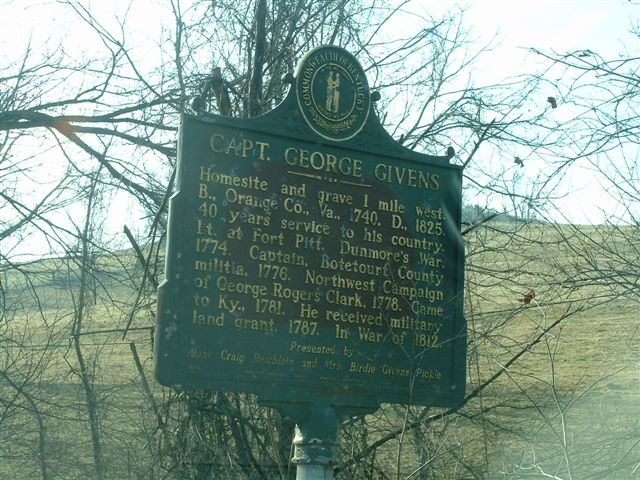
Captain George Givens
Homesite and grave 1 mile west. B., Orange Co., Va., 1740. D., 1825. 40 years service to his country. Lt. at Fort Pitt, Dunmore's War, 1774. Captain, Botetourt County militia, 1776. Northwest Campaign of George Rogers Clark, 1778. Came to Ky., 1781. He received military land grant, 1781. In War of 1812. Presented by Jane Craig Reichlein and Mrs. Birdie Givens Pickle.
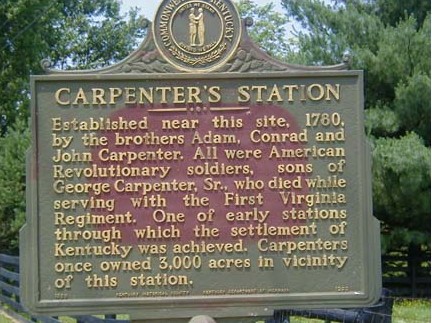
Carpenter's Station
Established near this site, 1780, by the brothers Adam, Conrad and John Carpenter. All were American Revolutionary soldiers, sons of George Carpenter, Sr., who died while serving with the First Virginia Regiment. One of early stations through which the settlement of Kentucky was achieved. Carpenters once owned 3,000 acres in vicinity of this station. Originally dedicated on May 17, 1969.
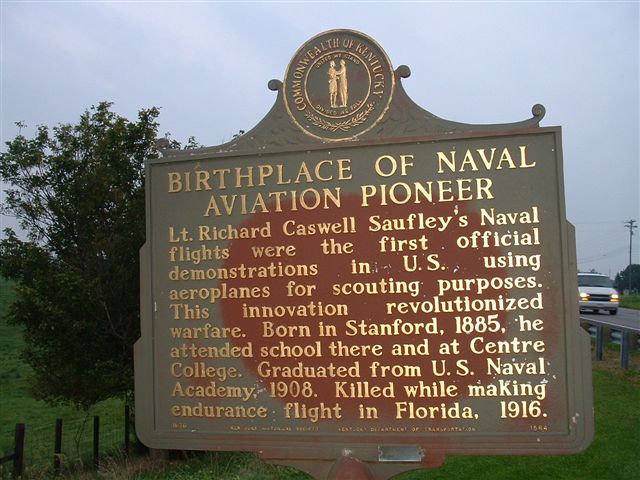
Lt. Richard Caswell Saufley
Lt. Richard Caswell Saufley's Naval flights were the first official demonstrations in U.S. using aeroplanes for scouting purposes. This innovation revolutionized warfare. Born in Stanford, 1885, he attended school there and at Centre College. Graduated from U.S. Naval Academy, 1908. Killed while making endurance flight in Florida, 1916. Reverse Description: Lt. Richard Caswell Saufley - This aviation pioneer was awarded two Aviation Medals of Merit by the Aero Club of America: one for efficient air service in an expedition, 1914, and another for breaking the world's altitude record twice in succession, 1915. U.S. Navy Saufley Field in Pensacola, Florida, and World War II destroyer named for him.
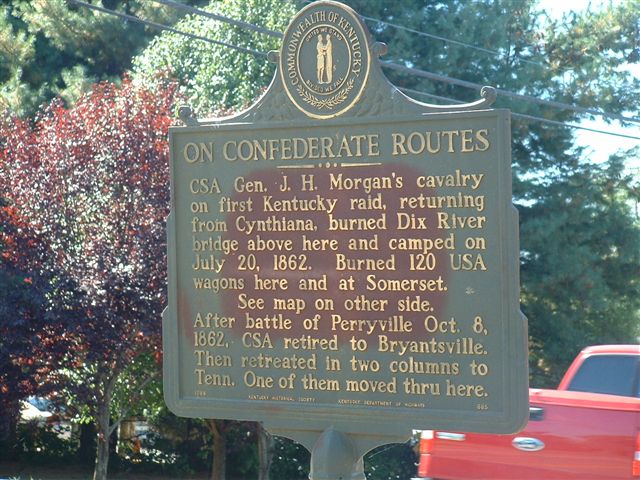
On Confederate Routes
CSA Gen. J. H. Morgan's cavalry on first Kentucky raid, returning from Cynthiana, burned Dix River bridge above here and camped on July 20, 1862. Burned 120 USA wagons here and at Somerset. (See map on other side.) After battle of Perryville Oct. 8, 1862, CSA retired to Bryantsville. Then retreated in two columns to Tenn. One of them moved thru here.Dedicated October 4, 1964.
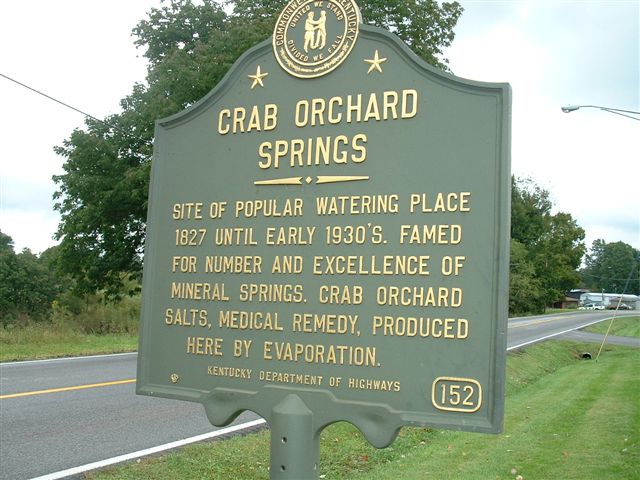
Crab Orchard Springs
Site of popular watering place, 1827 until early 1930's. Famed for number and excellence of mineral springs. Crab Orchard salts, medical remedy, produced here by evaporation.
Crash Of B-58 Hustler
At the height of the Cold War, on the night of Dec. 12, 1966, the residents of McKinney were startled by the sound of an explosion. Many locals converged on this hill to find a large fiery crater, and the wreckage of an Air Force B-58. All three crew members perished. Official cause never released to public. Over Given by friends, family, & citizens of Lincoln Co. Reverse Descriptioin: Fallen officers included the pilot, Major Richard F. Blakeslee, the navigator, Major Floyd E. Acker, and the defense systems operator, Captain C. Dale Lunt. They were returning from a training mission to Bunker Hill Air Force Base, Ind. B-58 was first supersonic bomber and a vital weapons system of the Strategic Air Command. Over Given by friends, family, & citizens of Lincoln Co.
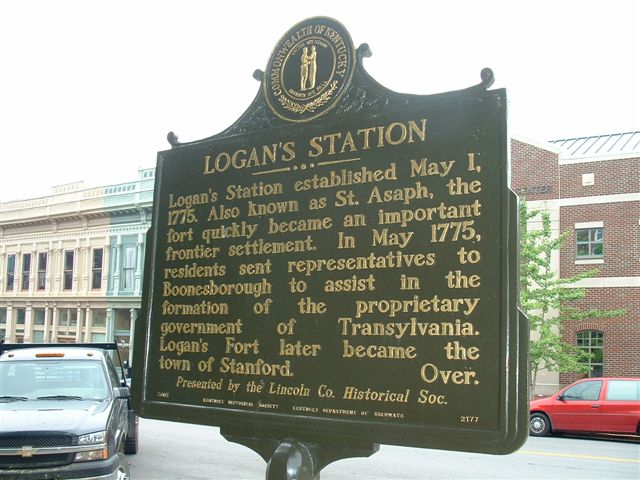
Logan's Station - Court House
Logan’s Station established May 1, 1775. Also known as St. Asaph, the fort quickly became an important frontier settlement. In May 1775, residents sent representatives to Boonesborough to assist in the formation of the proprietary government of Transylvania. Logan’s Fort later became the town of Stanford.Dedicated June 25, 2005. Reverse Description: Benjamin Logan left Boone’s Road, April 15, 1775, following trace that became the final segment of “Wilderness Road.” Logan’s path ran along an obscure trail from this area to Harrodsburg, then to Falls of the Ohio. The intersection of the trails became known as Hazel Patch, a junction 8 miles north of present-day London, Ky.
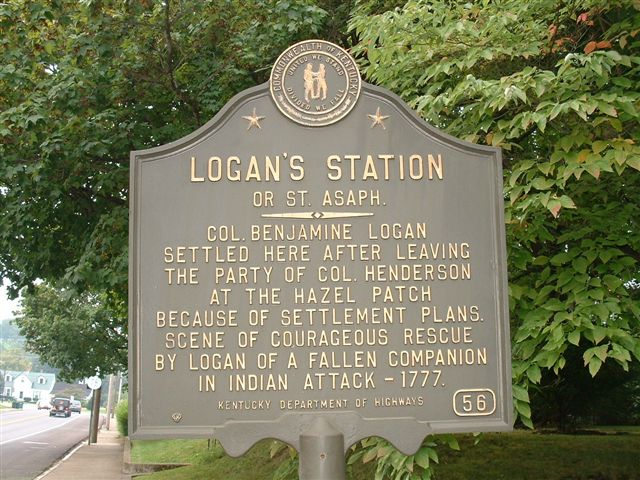
Logan's Station or St. Asaph
Colonel Benjamin Logan settled here after leaving party of Colonel Henderson at Hazel Patch because of settlement plans. Scene of courageous rescue of fallen companion by Logan in Indian attack (1777).
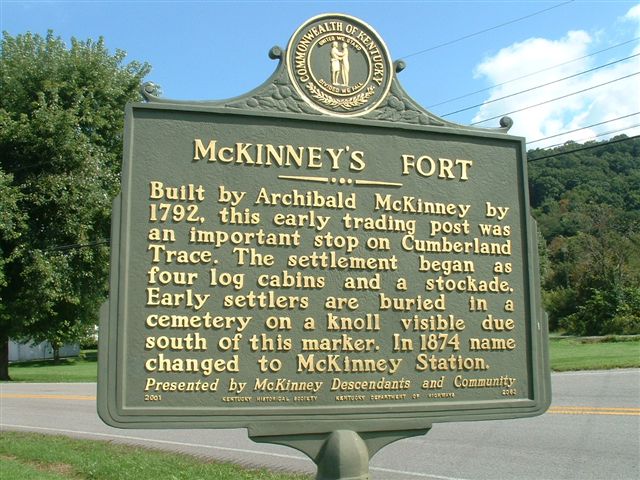
McKinney's Fort
Built by Archibald McKinney by 1792, this early trading post was an important stop on Cumberland Trace. The settlement began as four log cabins and a stockade. Early settlers are buried in a cemetery on a knoll visible due south of this marker. In 1874 name changed to McKinney Station. Presented by McKinney Descendants and Community. Dedicated July 28, 2001.
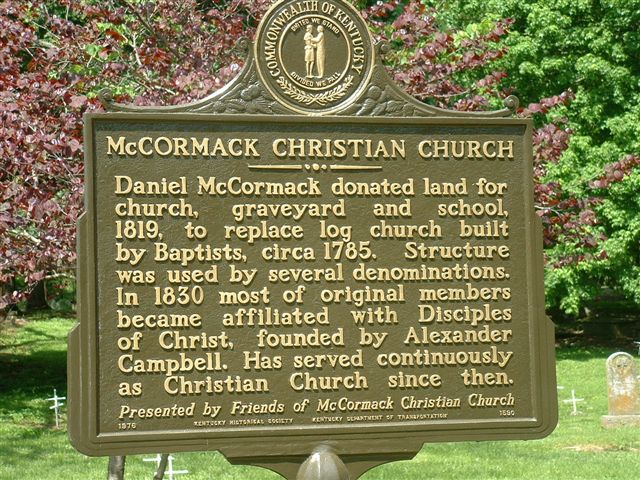
McCormack Christian Church
Daniel McCormack donated land for church, graveyard and school, 1819, to replace log church built by Baptists, circa 1785. Structure was used by several denominations. In 1830 most of original members became affiliated with the Disciples of Christ, founded by Alexander Campbell. Has served continuously as Christian Church since then. Presented by Friends of McCormack Christian Church. Reverse Description: McCormack Christian Church - Bricks laid in Flemish bond on stone foundation reflect Campbell's belief in simplicity of design and worship. Galleries for slaves were at each end. Stipulation by McCormack was that church was to be open to all denominations and people. It was listed on National Register of Historic Places, 1976. Presented by Friends of McCormack Christian Church.
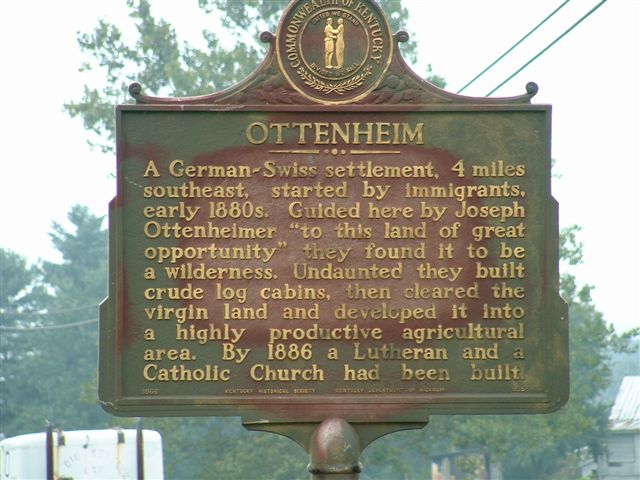
Ottenheim
A German-Swiss settlement, 4 miles southeast, started by immigrants, early 1880s. Guided here by Joseph Ottenheimer "to this land of great opportunity" they found it to be a wilderness. Undaunted they built crude log cabins, then cleared the virgin land and developed it into a highly productive agricultural area. By 1886 a Lutheran and a Catholic Church had been built
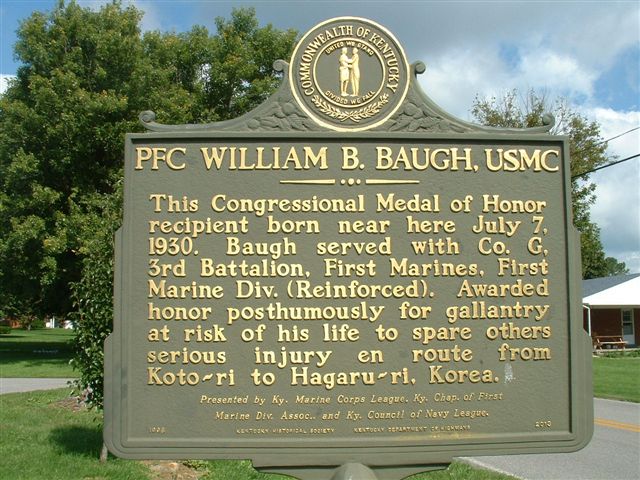
PFC William B. Baugh, USMC
This Congressional Medal of Honor recipient born near here July 7, 1930. Baugh served with Co. G, 3rd Battalion, First Marines, First Marine Div. (Reinforced). Awarded honor posthumously for gallantry at risk of his life to spare others serious injury en route from Koto-ri to Hagaru-ri, Korea. Presented by Ky. Marine Corps League, Ky. Chap. of First Marine Div. Assoc., and Ky. Council of Navy League. Reverse Description: Medal of Honor Winner - Baugh was serving as a member of an Anti-Tank Assault Squad during a nighttime enemy attack on a motorized column, when a hostile grenade landed in his truck. He shouted a warning to other Marines in the vehicle and hurled himself upon the deadly missile, saving his comrades from injury or death. Gave supreme sacrifice Nov. 29, 1950. Presented by Ky. Marine Corps League, Ky. Chap. of First Marine Div. Assoc., and Ky. Council of Navy League. Dedicated August 1, 1998.
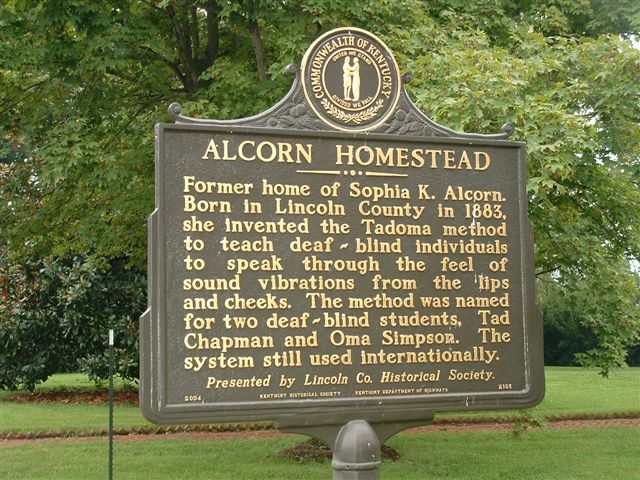
Alcorn Homestead
Former home of Sophia K. Alcorn. Born in Lincoln County in 1883, she invented the Tadoma method to teach deaf-blind individuals to speak through the feel of sound vibrations from the lips and cheeks. The method was named for two deaf-blind students, Tad Chapman and Oma Simpson. The system still used internationally. Presented by Lincoln Co. Historical Society. Reverse Description: Sophia K. Alcorn - Sophia Alcorn devised a system of written visual symbols to assist in developing speech in deaf children. Known as the "Alcorn Symbols," the system is used by teachers of deaf today. Remembered as educator from Ky. School for Deaf in Danville. She was active in Stanford Presby. Church. Died, 1967, and buried in Buffalo Springs Cemetery, Stanford. Presented by Lincoln Co. Historical Society. Dedicated March 27, 2004.
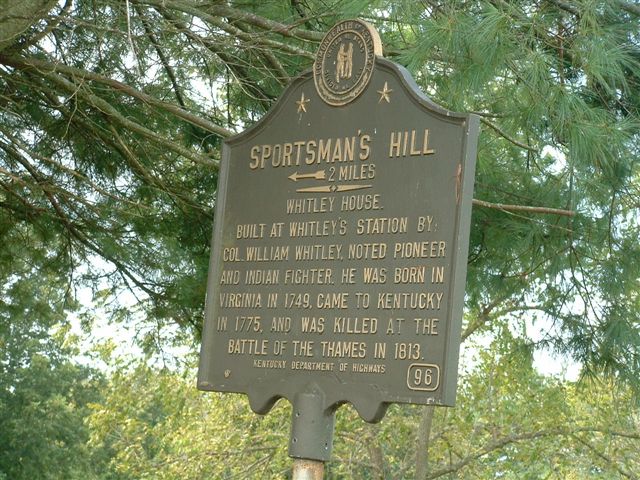
Sportsman's Hill original marker
Whitley House. Built at Whitley's Station by Col. William Whitley, noted pioneer and Indian fighter who was born in Virginia in 1749, came to Kentucky in 1775, and was killed at the Battle of the Thames in 1813. Additional Sportsman's Hill photos
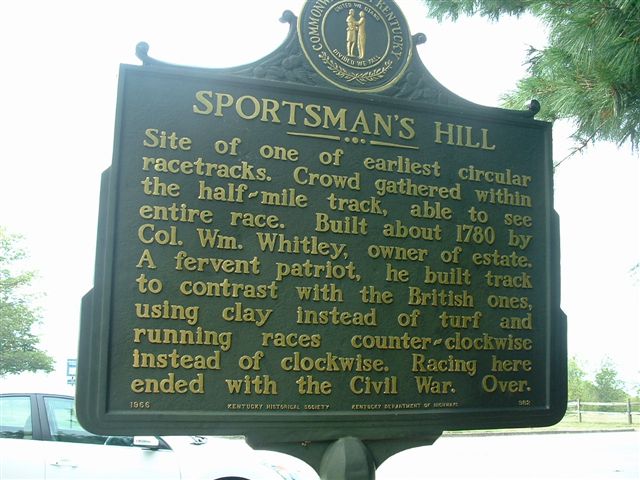
Sportsman's Hill at William Whitley House
Site of one of earliest circular racetracks. Crowd gathered within the half-mile track, able to see entire race. Built about 1780 by Col. Wm. Whitley, owner of estate. A fervent patriot, he built track to contrast with the British ones, using clay instead of turf and running races counter-clockwise instead of clockwise. Racing here ended with the Civil War. Over. Reverse Description:Whitley House-1785 - Located on the Wilderness Road, it was the first brick house in Ky. Situated so that racetrack was visible from it. Meetings held in fall, bringing elite of region here. After races, which started at dawn, lavish breakfast was served. Whitley, born Va., 1749. Famed Indian fighter; killed, Battle of the Thames, Canada, 1813. Whitley County, Ky., named for him. Over.
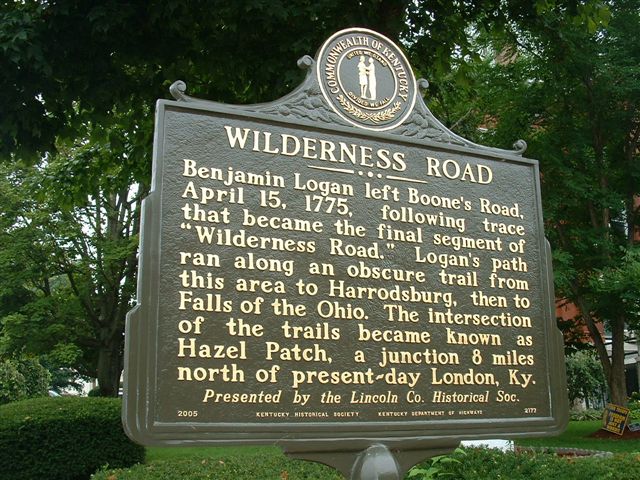
Wilderness Road
Benjamin Logan left Boone’s Road, April 15, 1775, following trace that became the final segment of “Wilderness Road.” Logan’s path ran along an obscure trail from this area to Harrodsburg, then to Falls of the Ohio. The intersection of the trails became known as Hazel Patch, a junction 8 miles north of present-day London, Ky. Reverse Description: Logan’s Station established May 1, 1775. Also known as St. Asaph, the fort quickly became an important frontier settlement. In May 1775, residents sent representatives to Boonesborough to assist in the formation of the proprietary government of Transylvania. Logan’s Fort later became the town of Stanford.Dedicated June 25, 2005.
Cherokee In Kentucky
Chiefs Oconostota, Attacullaculla, and Sewanooko signed the Treaty of Sycamore Shoals in 1775 which relinquished Cherokee claims to most of present-day Kentucky. It was the largest land cession in the history of the frontier, up to that time, and led to the settlement of forts Harrod, Boonesborough, and Logan’s Station. Reverse Description: Chief Doublehead (Chiqualataque), an influential leader in Cumberland Plateau region, frequently attacked Wilderness Trail and Ky. settlements in the 1700s. Wm. Whitley, Benj. Logan, and Isaac Shelby fought against his raids. Yet, the chief negotiated significant land & peace treaties and was a guest of Pres. Washington, Adams, and Jefferson. Dedicated October 19, 2013.
Bright's Inn
Bright’s Inn, a stagecoach stop near the Wilderness Road, was built in 1815 by Capt. John Bright. The original inn was constructed of logs, and, in 1820, a two-story limestone addition was built for travelers going from Lexington to the Cumberland Gap. Visitors to the inn included Isaac Shelby, George Rogers Clark & Henry Clay. Dedicated October 28, 2014.
Stanford Female College
The Stanford Female Seminary was incorporated by the Ky. Legislature on Feb. 26, 1869, but the name was changed to the Stanford Female College in 1871. The original brick structure (west side of building) was completed & the college opened in the fall of 1872. The next year, an addition was built & the original structure housed the students. Reverse Description: College was organized by citizens of Stanford to provide a collegiate education for their daughters. It had 83 graduates during its history. The school was forced to close in 1907, because it couldn’t compete with the public schools supported with tax money. After its closure, the Stanford Elementary School was located here until the 1930s. Dedicated April 25, 2015.
Baughman Mill
` Completed in 1881 and originally named Lincoln Mills, it struggled to be successful until purchased by S. H. Baughman in 1892. Joined by his brothers, Jim and John, and brother-in-law, Walter McKinney, it became J. H. Baughman & Co.The mill ground grain into flour, meal, and feed for livestock. It operated until John Baughman, Jr. retired in 1969. Over. Reverse Description: The mill contains logs from Kentucky’s first steam mill, Buffalo Mill, ca. 1848, and has always stood as a dominant town figure from its location above Main Street. Its piercing whistle once served as a signal for miles around Stanford, letting workers, farmers, and townspeople know it was time for a meal. Dedicated December 2, 2016.
The Cedars
` This home was built in 1853 by Dr. Thomas Montgomery, son of James Montgomery, a judge and congressman. His wife, the former Evaline Whitley, was the niece of Gen. Benjamin Logan, founder of Stanford, and granddaughter of Col. William Whitley, a Kentucky pioneer and military leader. Dr. Montgomery was a well- known physician, farmer, and politician. Reverse Description: This home is a fine representation of Greek Revival architecture and was one of the early brick houses in the area. It featured a wired doorbell system and was only the second home in Lincoln Co. to have a bathroom installed. Behind the house is a one-story brick dwelling that originally served as slave quarters. Placed on Nat’l Register of Historic Places, 1978. Dedicated December 2, 2016.